
Navigating public transportation in Prague — tickets, the Lítačka app, validation rules, and how to avoid a fine your first week.
One Ticket, Three Ways to Get It Wrong
Navigating public transportation in Prague is genuinely easy once you know the system — one ticket covers the metro, trams, and buses, and the network runs late enough that you’ll rarely need a car. New arrivals don’t usually get tripped up by the network itself. It’s the ticket type, the validation step, and the app’s activation delay.
If you’re still deciding whether to make the move, the Teach in Europe Guide covers the bigger decision. This post is just what to do once you land and need to get from the airport to your new apartment.
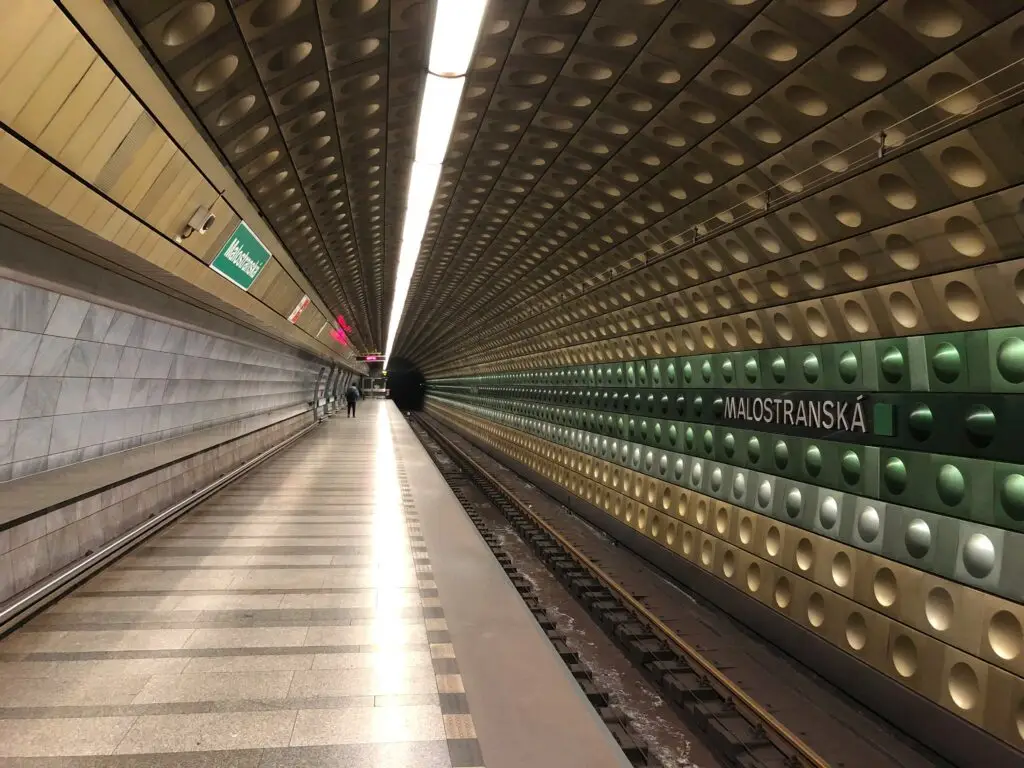
Malostranská — one stop from Prague Castle, and proof the metro is as clean as everyone says.
What Does Public Transportation in Prague Actually Cover?
Prague runs 3 metro lines (A, B, and C), more than 26 day tram routes, and 9 night tram lines that run until dawn — and a single ticket covers all of it. The system runs on time, not distance, so you can switch between metro, tram, and bus freely as long as your ticket is still valid.
Trams are often faster than the metro for short hops across the center, and the network was built around them long before it was built around cars. Most people navigate it instinctively within a day — the parts that trip up new arrivals are the ticket type and the validation rule, not the map itself.
What Ticket Should You Actually Buy?
Prague sells tickets by time, not distance or zone: a 30-minute ticket for a short hop, a 90-minute ticket for most single journeys, a 24-hour pass for a full day, a 72-hour pass for a long weekend, and a 30-day pass if you’re staying a month or more. A 90-minute ticket runs about 40 CZK, a 24-hour pass about 120 CZK, and a 72-hour pass about 340 CZK in the app (slightly more for paper).
Buying inside the PID Lítačka app is consistently the cheapest option, according to Howinczech’s official tariff breakdown. If you’re staying long enough to need it, a 30-day pass (around 550 CZK) beats buying day tickets within about two weeks of regular use — which is exactly why most teachers and long-term expats switch to it almost immediately.
How Do You Buy and Validate a Prague Transit Ticket?
Buy tickets at the yellow vending machines in metro stations and at tram stops, at Tabák/trafika newsstands, at ticket offices, or directly in the PID Lítačka app. MyCzechRepublic’s transit guide also notes an SMS option — texting a short code to a designated number sends a ticket to your phone within about a minute, though app tickets are quicker and now the more common choice.
Whatever you buy, validate it immediately. Stamp a paper ticket in the small yellow machine at the metro entrance or on the tram, or activate an app ticket before boarding. App tickets have a 1–2 minute activation delay, so buy one a minute before you need it — not as the tram pulls up. Contactless bank cards now work directly on some newer validators too. Each tap charges a new ticket, though, with no daily cap like a pass.
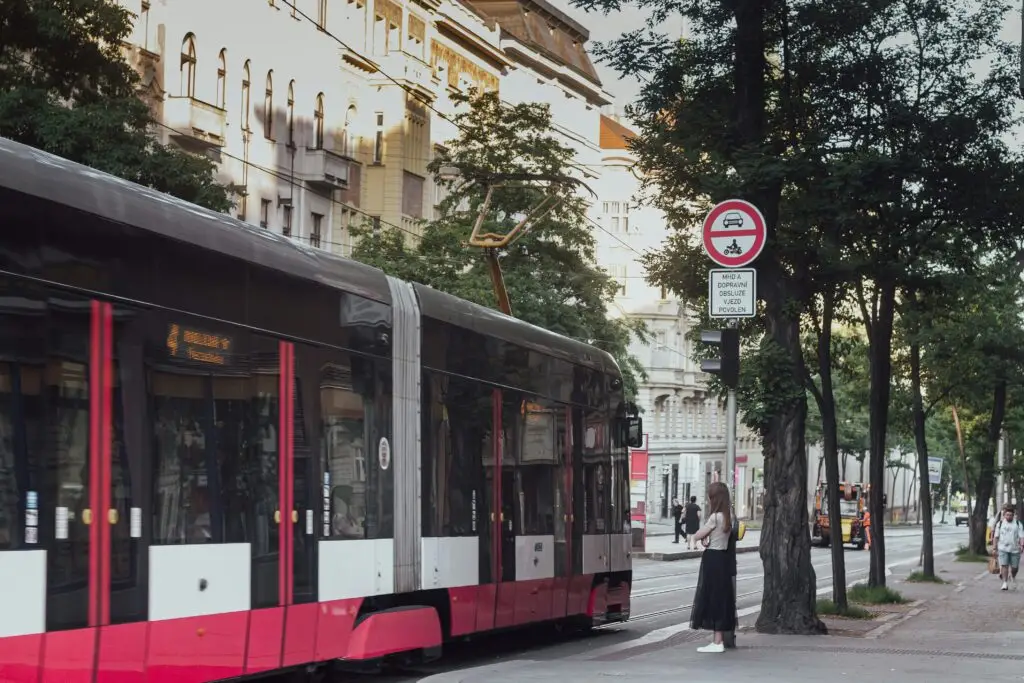
Waiting for the tram is the most Prague thing you’ll do all day — might as well get good at it.
What Happens If You Get Caught Without a Valid Ticket?
Plain-clothes inspectors check regularly, and they don’t accept excuses about a broken app or an expired battery. Fines run roughly 800 to 2,000 CZK depending on how quickly you pay, according to Roammate’s 2026 Prague transit guide — validate before you board, every single time, even for a two-stop hop.
A validated ticket is your only proof of payment. If an inspector stops you and your ticket isn’t validated, “I forgot” doesn’t help — the fine applies whether the trip was two minutes or twenty.
Is Public Transportation in Prague Accessible?
Prague’s metro is improving but isn’t fully accessible yet: about 48 of the 61 stations (roughly 79%) have elevator access, concentrated mainly on lines A and B, per Roammate’s accessibility data. Line C has decent coverage too, though gaps remain across the system.
Level boarding on metro trains involves a small gap that’s manageable for most wheelchairs, and new acoustic guidance standards took effect in March 2026 requiring beacon checks at all stations. If accessibility matters for your move, checking a station’s status before relying on it is worth a few extra minutes.
How Do You Get from the Airport Into the City?
Standard Prague transit tickets cover the trip in from Václav Havel Airport — no separate airport fare required. Trolleybus 59 replaced the old bus 119 back in 2024, so ignore any older guide that still mentions “119.” It runs from both terminals to Nádraží Veleslavín, where you transfer to Metro Line A for the center. Trolleybuses run every 4–10 minutes and take about 15–17 minutes to reach Nádraží Veleslavín. From there, it’s another 6–8 metro stops to stations like Malostranská, Staroměstská, or Můstek.
If your destination sits closer to Metro Line B, bus 100 runs to Zličín instead, connecting you to the yellow line. Either way, a single 90-minute ticket (about 40 CZK) covers the whole trip — the trolleybus or bus, plus the metro transfer, on one fare. Validate the moment you board. The rule doesn’t change just because you’re fresh off a flight with luggage.
Uber and Bolt both operate in Prague. Either is a reasonable option if you land with heavy luggage, or arrive late at night when transit runs less frequently. It costs more than the 40 CZK transit fare, but it’s a normal, reliable option here — not a workaround, the way it can feel in cities where ride-share is spotty or unreliable.
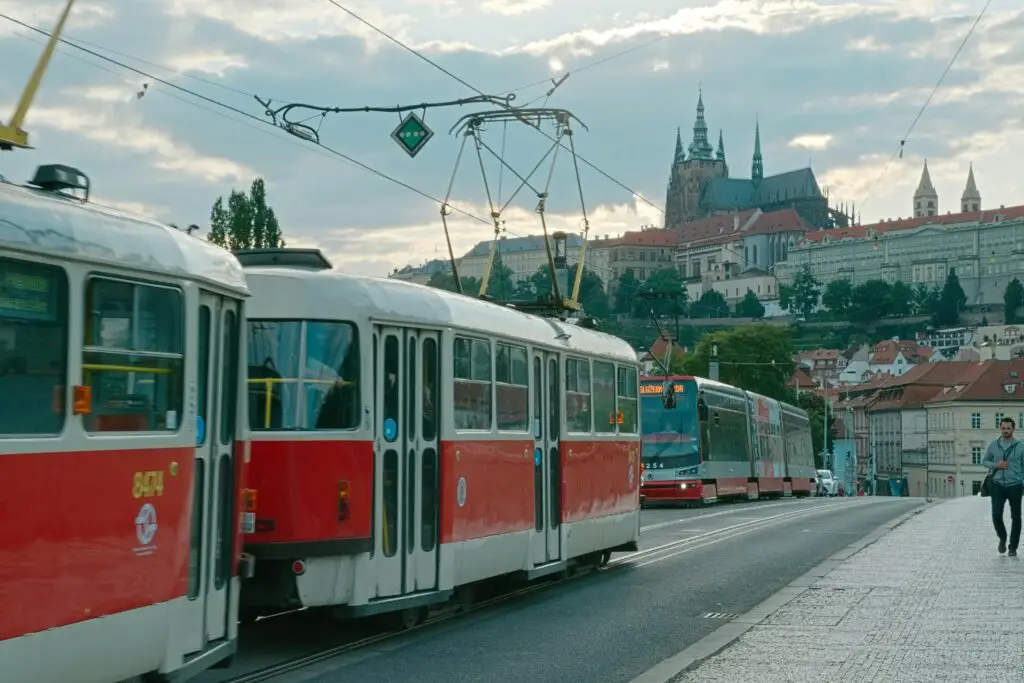
This is the view that makes the tram the better choice over the metro, every time.
What Does Knowing the Tram System Actually Unlock?
Once you understand the tram network, Prague stops being a map you follow. It starts being a city you actually explore. On my way home from work, I used to hop off the tram at a random stop. I’d wander that neighborhood for a while, then catch a different tram onward — no plan, no destination, just curiosity.
That only works because Prague’s trams are so interconnected. Once you know the system, you can reliably get home from almost anywhere in the city, which makes wandering low-risk instead of stressful. It’s one of the best ways to actually get to know Prague beyond the tourist core — not through a guidebook, but through whichever stop looked interesting that day.
The Etiquette Nobody Puts on a Ticket
Buying and validating a ticket is the mechanical half of navigating public transportation in Prague. The unspoken half — which side to stand on an escalator, how quiet the trams run, how locals queue — is covered in Czech Customs and Etiquette, and it’s worth a read before your first week, not after.
FAQs: Navigating Public Transportation in Prague
Q: Do I need a car to live in Prague? A: No — most residents, including long-term expats and teachers, rely entirely on public transit. The network covers the city well enough that a car becomes a rare convenience rather than a necessity.
Q: Is the Lítačka app necessary, or can I just buy paper tickets?
A: Paper tickets work fine and are widely available. The app is consistently the cheapest option, though, and lets you manage a 30-day pass without carrying anything physical.
Q: How strict are ticket inspectors in Prague?
A: Very. They’re plain-clothed and check regularly. They don’t make exceptions for tourists, expats, or a dead phone battery — validate every ride, no exceptions.
Q: What’s the cheapest way to get around Prague long-term? A: A 30-day pass, once you’re staying more than about two weeks. It pays for itself quickly compared to buying day tickets repeatedly.
The System Rewards Knowing the Rules
Prague’s public transport is genuinely one of the easiest parts of moving here. The trip-ups are small, specific, and entirely avoidable once you know them. Buy the right ticket, validate it immediately, and the rest takes care of itself.
For the bigger picture on moving to Prague, the Teach in Europe Guide covers the full decision. For daily life once you’ve settled in, see Cost of Living in Prague as a Teacher.
Get the Free Checklist if you are still figuring things out!